
Economy & Units
Economy
Isekai History
Behind the Scenes · full notes
- Economical activities stem from Fauna, flora, & beasts, and the goods/services derived from them. Economic activity is divided into 4 regions, where Comparative advantage determines which goods can be exported from one region to another.
Comparative Advantage
Behind the Scenes · full notes
- The ability of members of an economical region to carry out a particular economic activity more efficiently than members of another economical region
- *D.T.C must be accounted for when claiming in favor of or against.
Economical Regions
Behind the Scenes · full notes
-
Freeish Region
- This region consists of Forway, Triangle, Deltacross, Freeish, Blood, Sweetlake, Sundeath, and any other village within its shared boundaries.
- Members of this region focus on exporting a ton of flora and fauna.
-
Gandew Region
- This region consists of Forway, Flatland, Gandew, Sundeath, and any other village within its shared boundaries.
- Members of this region focus on exporting minerals, Wooly, and chitin.
-
Sanbi Region
- This region consists of Forway, Sanbi, Waterfall, Triangle, Tastyleaf, Endlessfog, and any other village within its shared boundaries.
- Members of this region focus on exporting Sanbi, fish-related products, etc.
-
Tolerideme Region
- This region consists of Forway, Tolerideme, Waterfall, Tastyleaf, Wingarest, and any other village within its shared boundaries.
- Members of this region focus on exporting Domar Carbey, Wood People, and Wingas.
Balls Currency
Isekai History
Behind the Scenes · full notes
-
The Common Currency among the four kingdoms was introduced by the Prosperity Treaty, Section #3, as bartering is forbidden among the treaty parties.
- Tolerideme
- Sanbi Kingdown
- Freeish Kingdown
- Gandew Kingdom
- All participants' cities around
-
Currency is created throughout the kingdom, and the respective city/kingdom embassy oversees its manufacturing.
Daily Salary
Behind the Scenes · full notes
- Average Daily salary. Work time varies per job and does not take into account things like fishermen who depend on their luck.
- Average Work day is 12 hours.
- See Economy Calculator
Weekly Salary
Behind the Scenes · full notes
- Average Weekly salary assumes pay for every day.
- Some professions do not accrue pay on days off.
- See Economy Calculator
Sapphire

Behind the Scenes · full notes
- Hardness
- 9
- History
- Mined in Flatland City to Blood City within the mountains at great depths (~1km)
- Slightly bigger than a fingernail. ~2cm diameter.
- Value
- Direct Conversions
- 1 Sapphire = 10 Aquamarine
- 1 Sapphire = 100 Amethyst
- 1 Sapphire = 5,000 Pearls
- Indirect Conversions
- Buy a fully grown tamed Egua
- Buy properties
- Slavery contracts.
- Buy guilds
- Buy specialized education.
- Tier IX+ Soul Energy
- Direct Conversions
Aquamarine

Behind the Scenes · full notes
- Hardness
- 7.5-8
- History
- Mined in Flatland City to Blood City within the mountains at great depths (~1km)
- Slightly bigger than a fingernail. ~2cm diameter.
- Value
- Direct Conversions
- 1 Aquamarine = 10 Amethyst
- 1 Aquamarine = 500 Pearls
- Indirect Conversions
- Custom-crafted armor/weapons, or good gear in general.
- Buy child tamed Eguas
- Buy adult tamed Big Wingas.
- Well protected/guarded travel.
- Fancier hotels.
- Some people’s entire life savings.
- Buy fundamental education.
- Fancy clothing, usually with gold or precious metals details
- Tier VI ~ VIII Soul Energy.
- Direct Conversions
Amethyst

Behind the Scenes · full notes
- Hardness
- 7
- History
- Mined in Flatland City to Blood City within the mountains at great depths (~1 km)
- Slightly bigger than a fingernail. ~2 cm diameter.
- Value
- Direct Conversions
- 1 Amethyst = 50 Pearls
- Indirect Conversions
- 1 Nari Stone.
- Common household Items such as a table, Fost lamps, etc.
- Fancier foods/Drinks.
- Average armor/weapons.
- Better Travel experience.
- Average lodging that often offers breakfast.
- Buy new, cheap clothing or some more refined clothing.
- Maps are usually priced at this rate for Aquamarine for more complex ones.
- Most Nari Gels, if desiring higher effect tiers.
- Tier IV ~ VI Soul Energy
- Sigil Rings
- Winga companion.
- Direct Conversions
Pearl

Behind the Scenes · full notes
- Hardness
- 2.5 - 4.5
- History
- Originally acquired by fishermen from Sanbi, but became a task dedicated to Cruros when they showed up since it was close to free labor.
- Slightly bigger than a fingernail. ~2 cm diameter.
- Value
- Direct Conversions
- Lowest component of the currency. See other ball types.
- Indirect Conversions
- Common Food & beer.
- Lodging for a day in a hostel or a cheap hotel.
- Some bargain/cheap armor/weapons.
- Hay for a horse.
- Travel by wagon, but not as comfortable or protected.
- Utensils.
- Buy used clothing, sometimes with wear and tear to some very cheap clothing.
- Most Nari Gels, if seeking weak-effect tiers.
- Tier I ~ III Soul Energy
- Paper, ink, etc.
- Direct Conversions
Balls Currency

Balls are the standardized currency as determined by the Prosperity Treaty. Each ball is about the size of a marble and is encrusted by the golden circular metallic decoration that protects the mineral inside and makes it harder to counterfeit or tamper with.
The most common currency is Pearls, which denotes the currency's minimum value. For reference, on an average working day, a gatherer of Gyut (a berry akin to Acerola) would earn one pearl per kg of berries picked (around thirty minutes to one hour of labor, depending on their efficiency.) Assuming a newbie gatherer worked for twelve hours, they would likely pay five pearls for a simple but hearty dinner with a mug of cheap beer, then another five for renting a humble hostel bed, with two pearls left over to save for tomorrow. Usually, one would use pearls for food or standard simple services like wagon rides for relatively short distances.
If you gather fifty Pearls, then you can trade it for a single Amethyst. Some books can be as low as a single amethyst if the janky ass printing presses back at Forway work well, but most people would use their amethyst to buy household items like fost lamps or live animals like a tamed Winga or pay their rent. Some clothing can be found for a few amethysts, but don’t expect them to be a pussy (or dick) magnet. You could skip the flatteries and just go to a brothel after drinking a few beers instead of not paying much attention to what you’re stuffing or being stuffed by. If you want to use your balls on something else instead, buy some nari gels, nari stones, or better lodging!
And if you somehow saved ten amethysts, then you can trade for a single aquamarine. You fancy! Don’t walk around showing it off, or some miscreant might request a “compulsory loan to keep you alive! You could buy a small egua for that price! Or even a tamed Big Winga! Or you can invest in yourself by enrolling at a local fundamental education school to open the door to new opportunities. If that’s not your thing, then you could do all the things amethysts can, but fancier. Fancier clothing, fancier hoes, and fancier beer too. Some people’s life savings amounts to one or a couple of aquamarines, so
You somehow got ten Aquamarines? Damm. You could trade that in for shiny Saphire. This is the scale of balls where you can obtain specialized education for you or your children. Depending on their worth, you can have someone bend to your will with life-long contracts in the tens if not hundreds of sapphires. Or you can buy properties and even guilds! The world is yours! But depending on where you go, you will need to hire adventurers to serve you as bodyguards, as some miscreants will love to have a chat with you. Or wear fake skin, and none would be the wiser.
Public text: economy-uoms.md
Vraki UOMs
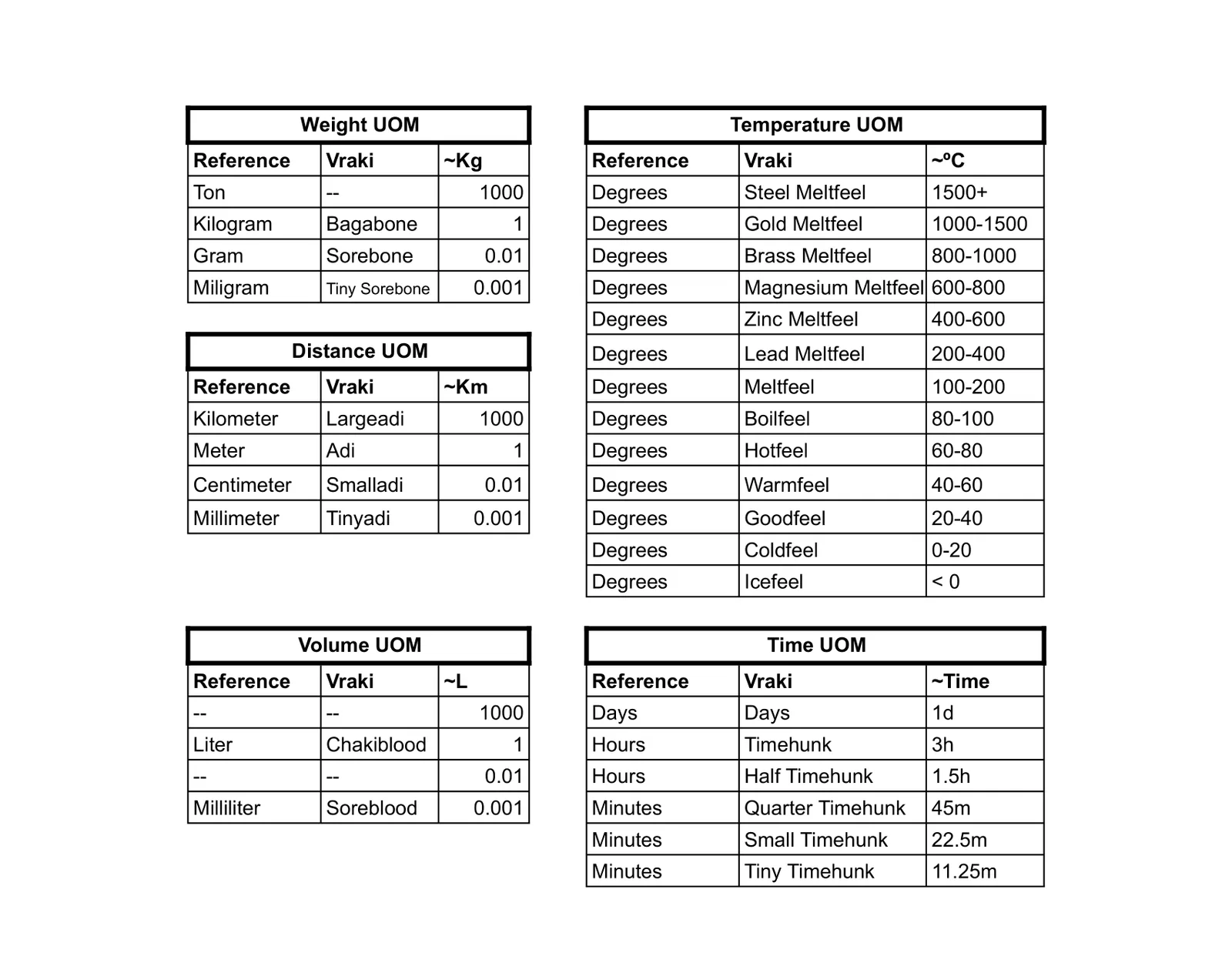
Before the Prosperity Treaty, Kingdom UOMs were all over the place, making trading harder and opening the door for sketchier traders to forge papers to evade authorities and rip off customers. Adrian, one of the courtroom scientists that overthrew all rulers at the end of The Greed Period, saw the treaty they were establishing as an opportunity to standardize all measurements based on using the most accurate one in existence—which happened to be the Tolerideme Kingdom, coincidentally where he was from. Gandew, of course, still uses their own to this day alongside the Vraki measurements. In contrast, everyone else's historical measurement implementations are now the type of knowledge that only historians care to know.
*The name Vraki is a homage to ancient texts that portrayed Buhraies working hard to unify language across species.
Public text: economy-uoms.md
10 more entries on this page are only in .
Built from: Legacy/Public/economy-uoms.md, Legacy/Behind The Scenes/World Lore/Economy.md