Time, Calendar & Units
Vraki UOM
Behind the Scenes · full notes
Vraki UOM
- Adrian (the same one who helped create the calendar) decided to standardize all UOMs based on the best UOMs being used around—which all happened to be from Blood due to their constant hunting nature.
- Temperature, Weight, Distance, Volume & Time UOM can be found on the World Calendar & UOM.
Source: Legacy/Behind The Scenes/World Lore/World Map, Name, Vraki Calendar & UOM, etc.md
Day & Night
Behind the Scenes · full notes
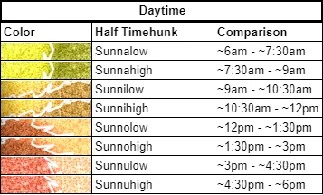
Vraki Day
- The Sun behaves similarly to our Sun.
- The day is divided into four sections, with each inner section divided into two (times are approximate due to seasons)
- Low vs High refers to the amount of Nari crystals ratio used in the mixture for each time chunk
Vraki Night
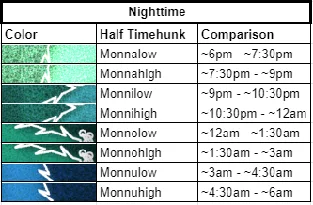
- The moon is similar to Earth, except for its color.
- See Timekeeper for more information.
- The night sky uses the color palette in the Moon section. #61f878

- If you focus the moonlight on a smaller point, you can make any living being glow within its shine. More info on World Timeline.
- The night has a similar design to daytime.
- Low vs High refers to the ratio of Nari crystals used in the mixture for each time chunk.
Source: Legacy/Behind The Scenes/World Lore/World Map, Name, Vraki Calendar & UOM, etc.md
Vraki Calendar & Birth Age
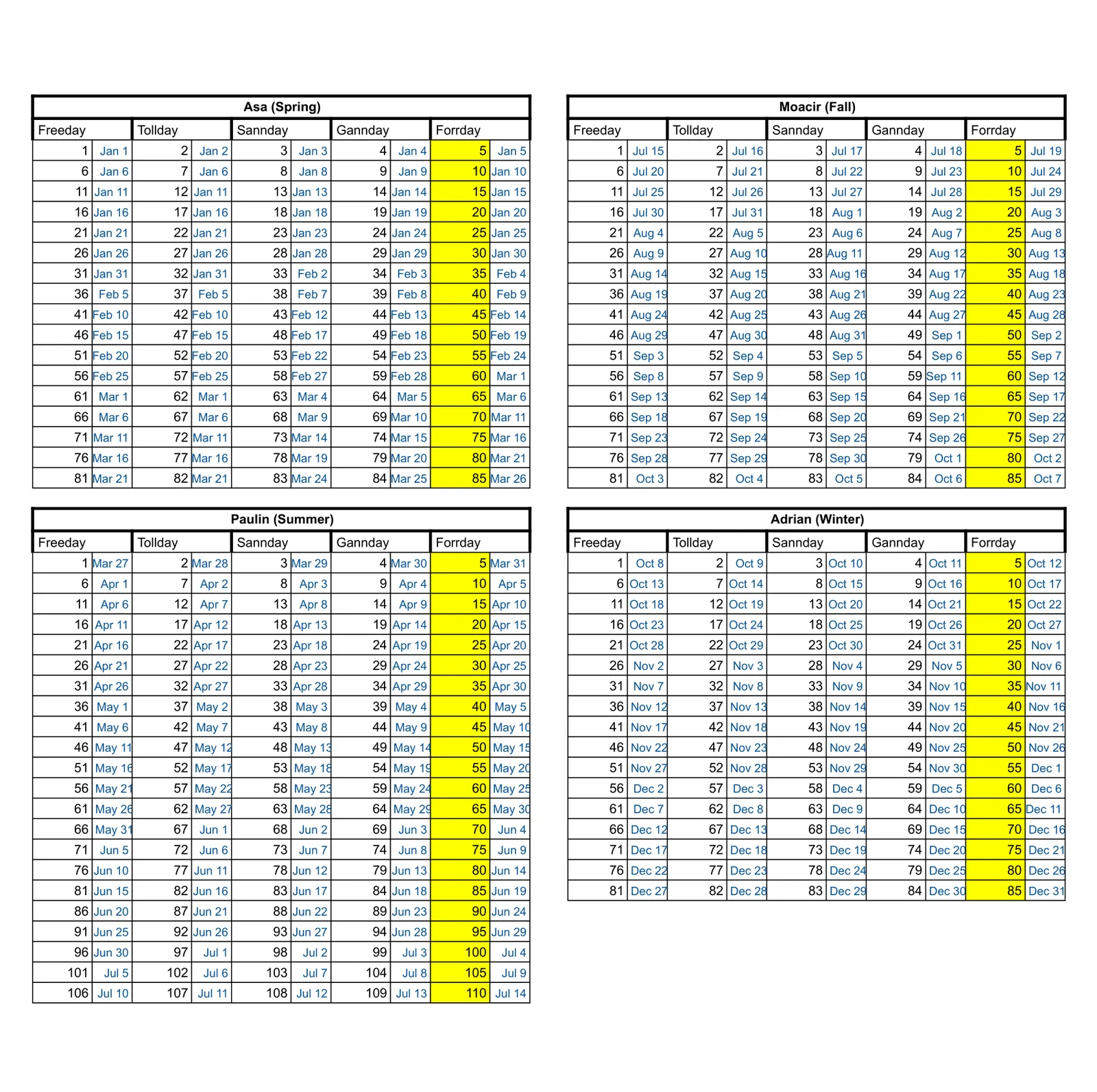
The Vraki calendar was adopted as the official calendar when The Prosperity Treaty was signed. Adrian, who spearheaded standardizing UOMs, also assisted in creating a standardized calendar. Wanting to immortalize themselves, he found a way to split a year amongst the courtroom scientist that created The Prosperity Treaty.
The start of the calendar is determined by the fall of Ganyrami; hence this new era is called After Ganyrami (A.G.), and everything prior to it is called Before Ganyrami (B.G.)
Each day of the week is named after one of the respective kingdoms, with Forrday being named after Forway and declared the end of the week (weekend).
On every Asa 1st, Forway also releases a lunar mapping for Hunters, farmers, adventurers, and others that depend on the lunar phases to gauge environmental tendencies for a measly twenty pearls.
*A mapping to the Gregorian calendar can be seen in blue.
Public text: time-calendar.md
Behind the Scenes · full notes
Vraki Calendar
- Created and standardized by ForWay City. See World Timeline for more information.
- On every Asa 1st, Forway also releases a lunar mapping for Hunters, farmers, adventurers, and others who depend on the lunar phases to gauge environmental tendencies for a measly twenty pearls.
- See the Isekai World Calendar for more information.
Year
- 4 Months
- 73 Weeks
- 365 Days
Month
- Named after the three courtroom scientists alongside the man who kickstarted the rebellion that led to the Prosperity Treaty (Freeish Paulin)
- Asa
- Represents Spring
- 85 Days
- 17 Weeks
- Paulin
- Represents Summer
- 110 Days
- 22 Weeks
- Moacir
- Represents Fall
- 85 Days
- 17 Weeks
- Adrian
- Represents Winter
- 85 Days
- 17 Weeks
Week
- Every week has 5 Days
- Freeday
- 1st day of the week.
- From Freeish Kingdom. They get the first day of the working week because they were where the rebellion began.
- Tollday
- 2nd day of the week.
- Work Day.
- Tolerideme was the second Kingdom to join.
- Sannday
- 3rd day of the week.
- Work Day.
- Sanbi was third.
- Gannday
- 4th day of the week.
- Work Day.
- Gandew Kingdom was the last kingdom to join.
- ForrDay
- 1st day of the week.
- Forward Day.
- A day when all embassies are closed to the public.
Birth Age
Age is the number of years a person has been alive as of the current year. Day/Month has no meaning to a person's age.
Source: Legacy/Behind The Scenes/World Lore/World Map, Name, Vraki Calendar & UOM, etc.md
Seasons
Behind the Scenes · full notes
Average Temperature Table
| Δ0km | Δ2km | Δ4km | Δ6km | Δ8km | |
|---|---|---|---|---|---|
| Asa (Spring) | 20 ºC | 15 ºC | 10 ºC | 0 ºC | -10 ºC |
| Paulin (Summer) | 30 ºC | 25 ºC | 20 ºC | 10 ºC | 0 ºC |
| Moacir (Fall) | 15 ºC | 10 ºC | 5 ºC | -5 ºC | -15 ºC |
| Adrian (Winter) | 10 ºC | 5 ºC | 0 ºC | -10 ºC | -20 ºC |
Average Humidity Table
| Δ0km* | Δ2km | Δ4km | Δ6km | Δ8km | |
|---|---|---|---|---|---|
| Asa (Spring) | 85% | 75% | 65% | 50% | 40% |
| Paulin (Summer) | 90% | 80% | 70% | 55% | 45% |
| Moacir (Fall) | 85% | 75% | 65% | 50% | 40% |
| Adrian (Winter) | 75% | 65% | 55% | 40% | 30% |
*If close to water like Sanbi Kingdom. If not, treat like Δ1km
Source: Legacy/Behind The Scenes/World Lore/World Map, Name, Vraki Calendar & UOM, etc.md
Name Schema
Behind the Scenes · full notes
Four Kingdoms
- To make names, contracts, and negotiations easier, Forway implemented a naming schema that began with any kingdom child born after the prosperity treaty came into effect in 671 A.G.
- NAME PLACE GUILD
- Given by parents at birth. Uniqueness and name characteristics vary by region.
- City of origin or main residence.
- City of origin or main residence.
- Often associated with where their primary guild is located.
- Guild Name. If participating in multiple guilds, then any of them.
- If the guild name is described as CITY-GUILD, and the city is the current place of the badge owner, then it is not written (e.g., Itagiba Sanbi Royal vs Itagiba Sanbi Sanbi-Royal)
- If not participating in any guild, this part of the name is skipped.
Source: Legacy/Behind The Scenes/World Lore/World Map, Name, Vraki Calendar & UOM, etc.md
Map
Behind the Scenes · full notes
Isekai History
- It is unknown how old the planet is, but it is estimated to be billions of years old.
Isekai Global Map
- The World Map created by the Four Kingdoms is located in the southern part of the planet.
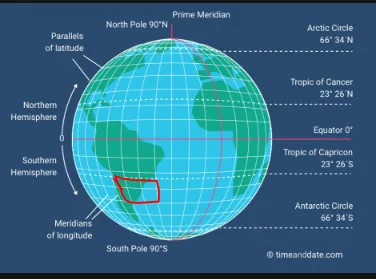
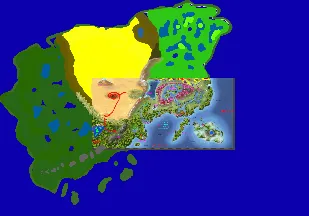
Four Kingdoms
- See the Four Kingdoms Map
Unknown Regions
- See Four Kingdoms Metadata Map
Source: Legacy/Behind The Scenes/World Lore/World Map, Name, Vraki Calendar & UOM, etc.md
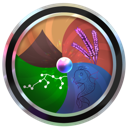
Time Keeper
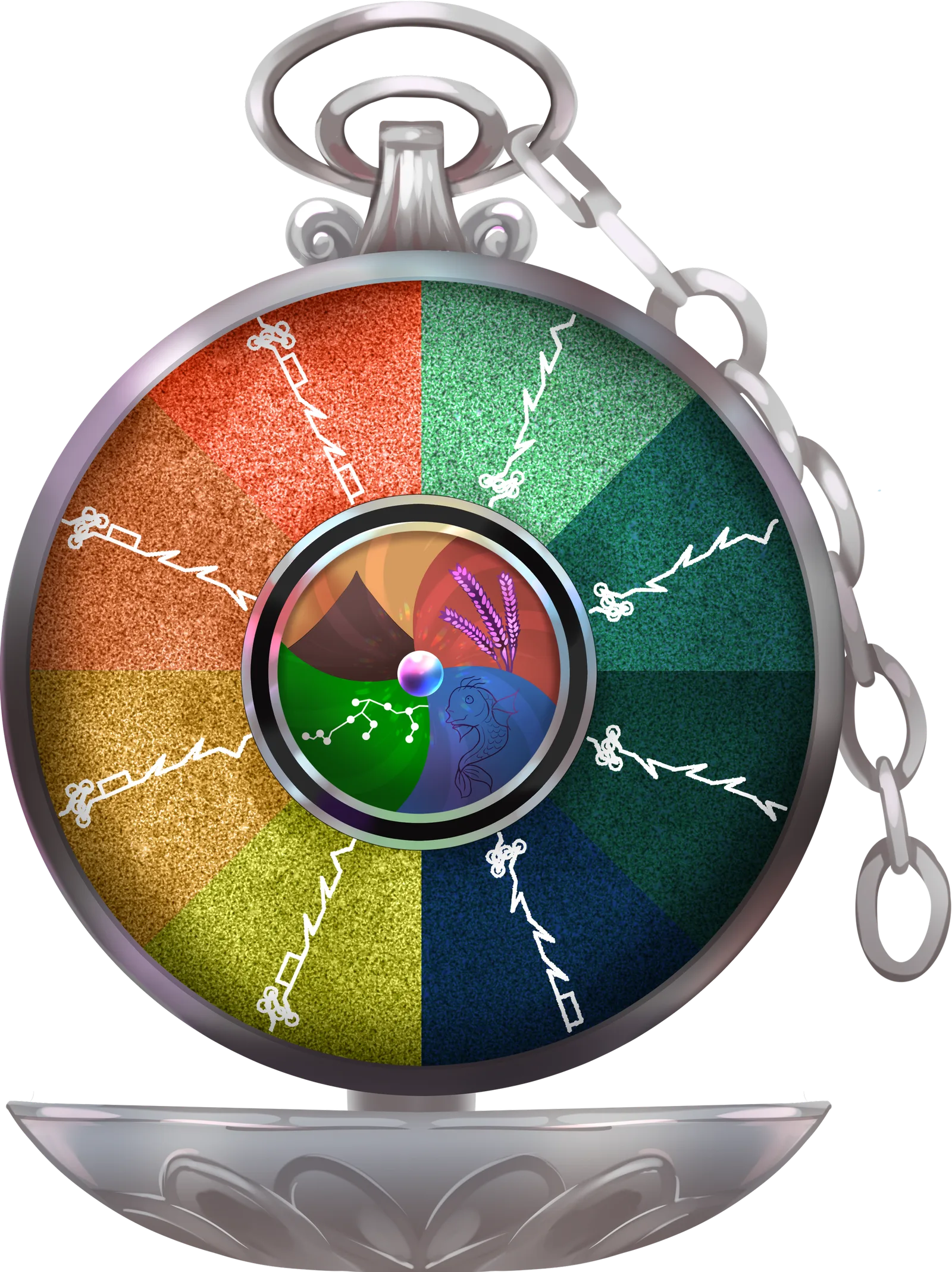
Akin to a sundial, the Time Keeper tells the time of day by shining it with sunlight or moonlight. Shortly after, you will be able to tell the time based on which section is growing bioluminescent.
To read the Time Keeper properly, start from the bottom (6 o’clock), where the separation between yellow and navy blue sections represents sunrise. The entire yellow chunk is Sunna, equivalent to a timehunk, or about three hours. The Vraki writing within it breaks down the timehunk into half timehunks called Sunnalow and Sunnahigh.
Going clockwise from the start (6 o’clock), you would read out the time as follows:
Sunnalow, Sunnahigh, Sunnilow, Sunnihigh, Sunnolow, Sunnohigh, Sunnulow, Sunnuhigh.
The edge between red and light green (12 o’clock) represents sundown, and if you continue to read out clockwise, the half timehunks are:
Monnalow, Monnahigh, Monnilow, Monnihigh, Monnolow, Monnohigh, Monnulow, Monnuhigh.
Time can be further divided into quarter, small, and tiny timehunks, but one would use a Time Counter (akin to a sand clock) to do so, as day-to-day interactions are often expressed as “Let’s meet at Moonahigh for some fun time.”
Kingdom’s culture over how close they keep track of their Time Keepers varies substantially. The most common example is that Sanbians are rarely on time, while Toleridemians are unnecessarily punctual.
Public text: time-calendar.md
5 more entries on this page are only in .
Built from: Legacy/Public/time-calendar.md, Legacy/Behind The Scenes/World Lore/World Map, Name, Vraki Calendar & UOM, etc.md